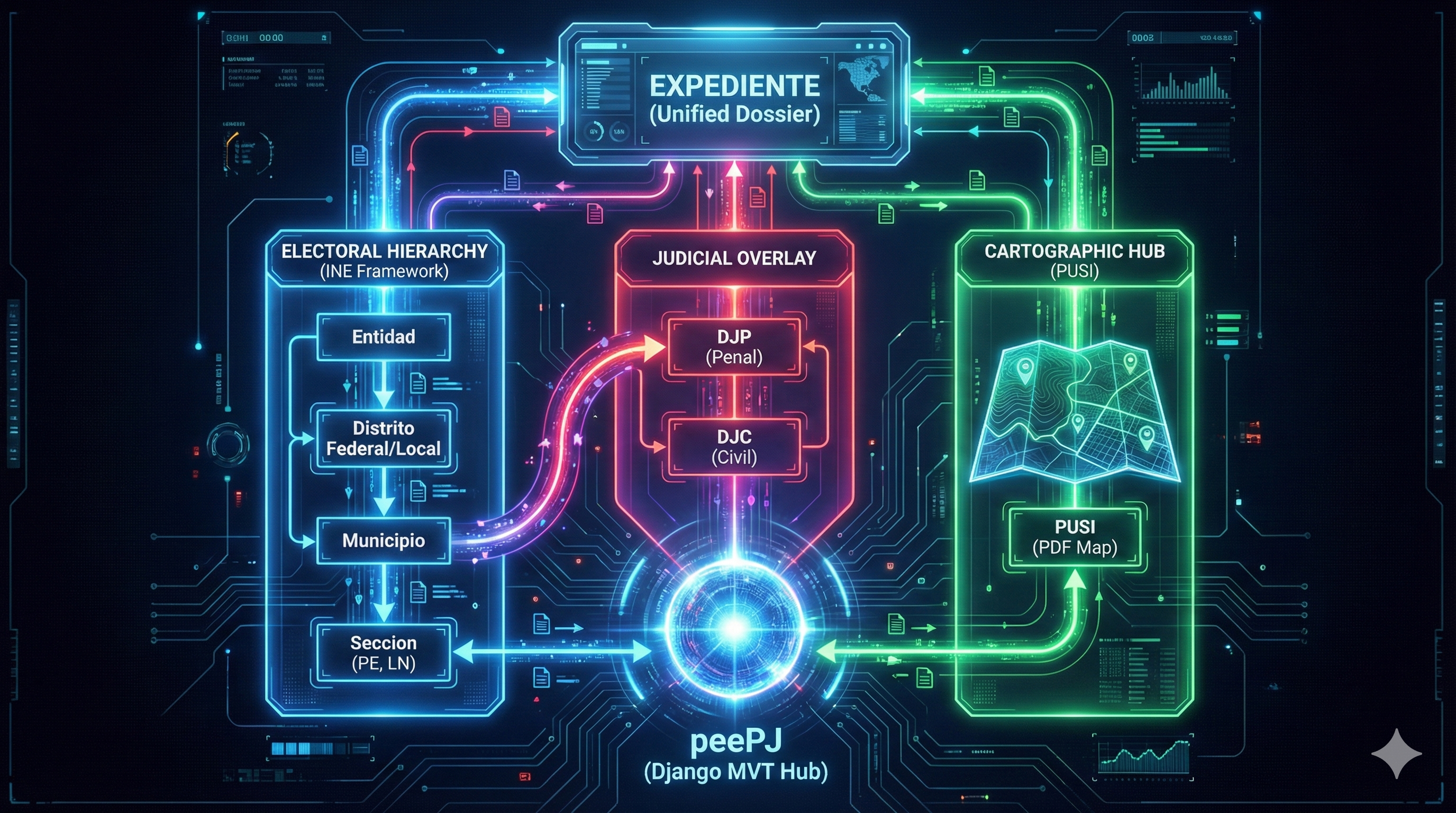
When analyzing a new software project, the primary goal is to answer the question: “What problem does this solve?”. In the case of ‘peePJ’, the answer lies in the intersection of electoral administration and judicial organization.
After examining its data models, dependencies, and structure, it’s clear that ‘peePJ’ is not a generic application. It is a specialized System for Consulting Electoral and Judicial Geography, designed to be an essential tool for the operational personnel of electoral institutions.
Let’s deconstruct how we arrive at this conclusion.
The Architectural Blueprint: A Pragmatic Foundation
‘peePJ’ is built upon the robust and industry-standard Django framework, utilizing its Model-View-Template (MVT) pattern. This choice provides a clean separation of concerns:
- Model: The database schema, which brilliantly codifies the complex territorial structures.
- View: The business logic that retrieves and processes the data.
- Template: The presentation layer that generates the user-facing “expedientes” or information dossiers.
This architecture is pragmatic and effective. A key feature derived from this design is its database-agnostic nature. While it can run perfectly on a simple file-based database like SQLite for development, it is fully prepared to connect to enterprise-grade database engines (like PostgreSQL, Oracle, etc.) for production environments, ensuring scalability.
The Pillars of ‘peePJ’: The Core Data Models
The true purpose of ‘peePJ’ is revealed in its gis/models.py file. The data models are the pillars that define the system’s capabilities, meticulously representing the official territorial frameworks.
Pillar 1: The Electoral Hierarchy (The INE Framework)
This is the system’s backbone, digitally mirroring the national electoral geography as it applies to a specific state.
Entidad: The top-level model, representing the federal entity (in this case, Tlaxcala).DistritoFederal&DistritoLocal: These models define the two fundamental types of electoral districts within the state.Municipio: This model represents the municipal division, which is a key level for both political and administrative organization.Seccion: The foundational unit of the entire electoral structure.
Each section contains the most granular data: the pe (Padrón Electoral) and the ln (Lista Nominal), which are the critical metrics for any electoral analysis. This hierarchy allows the system to aggregate voter data from the section level all the way up to the entire state.
Pillar 2: The Judicial Overlay
Herein lies the unique value proposition of ‘peePJ’. The system doesn’t just stop at the electoral map; it integrates the state’s judicial geography.
DJP(Distrito Judicial Penal) &DJC(Distrito Judicial Civil): These models represent the judicial districts for criminal and civil matters.- The Connection: The crucial link is established at the
Municipiolevel, where each municipality is mapped to its corresponding judicial districts (DJPandDJC).
This pillar solves a common problem for electoral bodies: understanding how the electoral map aligns with other administrative or judicial structures. It allows users to answer questions like, “Which municipalities and electoral sections fall under the jurisdiction of a specific court?”.
Pillar 3: The Cartographic Integration (The PUSI)
While ‘peePJ’ is not a map-generation tool, it is designed to be a cartographic data hub.
- PUSI (Plano Urbano por Sección Individual): The system acknowledges the importance of this official INE cartographic product. A PUSI is the detailed map of an individual electoral section.
- Integration, not Generation: The application’s role is not to create these maps, but to serve as the definitive repository that links every
Seccionto its correct, externally-generated PUSI in PDF format.
The scripts found in the utils/ directory, such as clean_pusis.py, are designed to manage and organize these assets. This pillar ensures that when a user consults the dossier for a specific section, they are also presented with the official, corresponding map.
The Big Picture: What is the Purpose of ‘peePJ’?
Individually, these pillars represent different administrative views of a territory. When integrated, they form a powerful, unified system.
‘peePJ’ is a centralized, single source of truth for the electoral and judicial geography of an entity.
Its purpose is to empower the staff of electoral institutions by:
- Consolidating Data: Breaking down silos between electoral, demographic, and judicial information.
- Ensuring Consistency: Providing a single, reliable reference for overlapping territorial divisions.
- Streamlining Operations: allowing for the rapid generation of detailed expedientes (dossiers) for any geographical unit.
The name itself, peePJ, likely reflects this dual nature, possibly standing for an acronym related to the Padrón Electoral y Estadístico and the Poder Judicial. It is a purpose-built tool designed to bring clarity and efficiency to a critical aspect of electoral management.